Tuesday, 26 April 2016

Lace Market Theatre and the Bard


To coincide with all things Shakespeare (and today being his registered day of birth) read below for a Nottingham secret and piece of TV that must be seen.

On Saturday, I had the good fortune of booking tickets to see A Midsummer Night's Dream on the 400th anniversary of his death day. (Unknown to me.) Now this isn't a review about that production. (It was great by the way.) But more about the place it was in.

The Lace Market Theatre is a hidden gem in Nottingham. Literally just up the around from a main street, take a right and you're there. It is loving run by volunteers who put on a vast range of plays. (And if the one I saw is anything to go by then they are very enjoyable indeed.) Just alerting you all to its existence. Should you want some cheap, good quality theatre. Support your local!

In other theatre *cough*Shakespeare*cough* related news - the BBC. The BBC did good. To celebrate this strange anniversary, the Royal Shakespeare Company in Stratford-upon-Avon put together a cracking line up for Shakespeare LIVE! It's the best type of this TV that I've seen in a while. The programme did a great job of encompassing the mass influence the Bard has had across art forms and generations. A slurry of famous names took part, as well as multidisciplinary performers from across genres. From opera, ballet and musical theatre to hip hop, jazz and more traditional renditions of Shakespeare. It had it all. And it was great. It will be available to watch on BBC iPlayer if you live in the UK. Definitely worth a sit down and catch up. 

Sunday, 24 April 2016

The Glasgow International Chronicles: Part IV


So little bit late in terms of the Glasgow International. But this exhibition is on until 19th June (so I feel like I can be pardoned for my lateness.)

Akram Zaatari, a Lebanese artist, presents selected works at this new exhibition for The Common Guild in Glasgow. My favourite piece in the exhibition was 'Tomorrow Everything Will Be Alright', 2010 - a 12 minute video. (See the image above.)

This whole exhibition deals with love, cultural identity and the development of technology. This is only a quick post to say this is an intriguing exhibition to see. It is rare that non-western work is presented within the contemporary art scene with such weight, and these works slip in there effortlessly with their valid contribution. What I liked the most about the exhibition is that his Arab roots are very much in the work, but they do not drown it. It's a very subtle presence that adds to what is trying to be said, rather than consuming the whole concept.

If in Glasgow - go and see. (It's free!) Also he is the founder of the Arab Image Foundation, which is an artist-driven organisation with a collection of over 600,000 images (started in 1997) to preserve photographs from the region - something that is worth a peek.

That concludes 'The Glasgow International Chronicles'. I hope you enjoyed the whirlwind tour of what I had to say on this marvellous contemporary art festival! Definitely something that is worth keeping on your art radar.

Wednesday, 20 April 2016

Flatpack Film Festival 2016


We interrupt this Glasgow slurry of posts to give you an update about goings on in the middle of the country: Birmingham.

Flatpack is a film festival (and so much more) that is currently taking place in the city until 24th April. Many events are free and some are paid for. They have a variety of things programmed for this annual festival, all of which can be found here.

Today, I saw a free screening in Birmingham's Gas Hall in the west of the city. Aptly named 'Pic 'n' Mix' the screening played a range of international shorts that have been played across the film circuit.

Five shorts were shown in total. Each very different from the next. The first was perhaps my favourite. It was a small snippet of an exchange between three brothers trying to recreate a childhood photograph of them in the bathtub for their mother's birthday. Only they are full grown adults now and argue as siblings do. It was a very true, realistic and funny story of family. I loved the premise, the actors were brilliant and the writing completely natural. They cleverly kept it very simple and in doing so allowed the message to carry through. Perhaps because it was so relatable is why I was so drawn to it. Anyway, here are the details of the film: The Bathtub, Director: Tim Ellrich (Germany/Austria 2015 – 13 mins)

The others were all really enjoyable (bar the second one which was about farming which I didn't connect to - found it boring). One told the story of a widower wanting to buy the plot next to his wife's grave but things going array (eye). The other, an animation following one creature's obsession with a red coat. And a family's small talk captured at key points throughout a year.

If you want to catch the second half of this showing (focusing on home grown talent instead of abroad) you can do so on Friday (tomorrow) at: BM&AG - Gas Hall at 5.30pm until 6.30pm

Definitely check out what is going on and go go go to something if you can.

The Glasgow International Chronicles: Part III


Next on my list of my whirlwind tour of Glasgow International is the Centre for Contemporary Arts (CCA). Entrance is free!! In conjunction with the festival, the space has been taken over with some specially commissioned pieces. I had chance to see three out of the four exhibits, one whole heartedly recommended, one slightly recommended and the other unfortunately not so much. But it comes down to taste rather than quality in this instance I feel.

First, the not so great. (Now my opinion might be bias as this was the last one I visited and I was aware I was on a time restriction.)

Third Hand: Autonomous Art from Scottish Prisons. This exhibition is in until 23rd April. For opening times check the CCA website. This exhibition is a tin. (Does what it says.) The show presents works of art created by prisoners creating artwork for the first time. For me, (and although it is a great cause and premise (any introduction of making into anybody's life at any time has nothing but a positive impact in my eyes)) it lacks the criticality that is present in other art of similar vain. It follows the trend of 'outsider art' but instead of presenting the show with the same validity of other contemporary art shows, it looses its chance to ask the audience to see beyond the labels of 'naive' and 'outsider art' as the brochure suggests. It feels crammed into a little corner of a room. (I wasn't that into the artwork itself either. What can I say? Sometimes you like what you like and you don't what you don't.) If you are there in the building already you might as well have a skirt around. But I wasn't that into it.

Now the slightly recommended. This exhibit is called: The Polity of (symbol) and is open until 25th April. Open daily.

The exhibition is particularly pertinent today due to the theme it deals with. Φ is (quote) a floating nomadic country without possession of any landmass rooted on earth, whose occupants live, work and play together as an autonomous community. This utopian state is manifested in the form of an intergalactic vessel. 

This exhibition is part of a community-led research project, encouraging an open dialogue on the right to inhabit specific geographies instigating an inquiry into who exactly is welcome in Britain. 

They try and create a different experience as soon as you enter the door. (If I'm honest it reminds me of a parody of a cult (the kind of representations in films.)) Flags are hanging everywhere, what feels like a propaganda film plays in the background promoting this version of society. A row of chairs (ready for unannounced rallies) faces an official looking set up. Government booths which you approach to fill out a form to receive a visa. Dependent on how you fill the form, depends on whether or not your visa is accepted.

I completely get what they were trying to do - and I did enjoy it. The only thing was the visa application. What I thought would be a double sided sheet was a full on A5 booklet full of very difficult questions about geography and current/historical affairs. Now I'm not very good at this when it comes to my own country, so when it was focussed on Africa and Asia I really struggled. Particularly as some of the events focussed on living memory but before my year of birth. (A lady never tells her age, but I'll let you know it's the early 90s.) I liked that it highlighted how ignorant we are when world issues not concerning the West/ Europe are not as valued or known as the rest of the world. But, after the third page of these difficult questions, the visa application just made me feel stupid. I think it was too long, and because of that they may struggle to get all the answers they wanted, as half way through I just started to guess them all unless I thought I knew the answer.

In summary: nice idea. Not realised to the best of its potential. Worth a sniff.

Finally, and not least by any means, the exhibit I found myself drawn to. (In honesty, I came to see the exhibition mentioned above, but I fell in love with this one.) Simply named after the artist (Pilvi Takala) the show displays an overview of her work to date. (Including a new commission by Creative Scotland to revisit a previous performance.)

She intelligently investigates social situations and human behaviour by subtly subverting the norm. (Essentially, Takala becomes the unexpected in a regular situation with invisible written rules that are followed by everyone else. She successfully, very gently, disrupts societal routine to create quiet ripples that have very present and very visible repercussions.)

Her work primarily exists in video. There were some key standouts from her selected works that were on display that made me question things I wouldn't have given a second thought to before.

The Trainee, 13.52 min, 2008.

This was a month long project where the artist (with only a select few knowing of the true reason of her being there) posed as a marketing trainee using odd working methods. She shifted her focus from working to thinking. For example, the film shows her repeatedly riding the lift up and down the different floors of the office building 'thinking'. Some colleagues found this amusing, some clearly thought she was weird. This particular exercise she tried ended in an email being sent to her manager. She tries other tactics to subvert the norm - so I thought this film was definitely worth a watch.

To briefly name a few others I would recommend researching:

  • Wallflower, 10.25 min, 2006
  • Easy Rider, 4.25 min, 2006
  • Broad Sense, 8.36 mins, 2011
  • Lost Pigeons, posters, phone, 5 min sound, 2012 

The exhibition had a very clean and simple layout, with one room dedicated to a piece entitled Broad Sense. Once finished with this room, the long rectangular space is transformed by multiple TVs hung from the ceiling, each with two chairs. (Good choices of seating here. Tate take note.) But the extra touch that worked so well was that the clothes (or props) that featured so heavily in a few of the pieces are slung across the back of the seats you sit on to watch the work. It was a nice reminder to the reality and physical presence that these pieces have that can sometimes feel distanced because of the media used to capture these happenings. It brings the immediacy of the work to the forefront of the audience's mind again. These pieces don't work in isolation with no contextualisation on our part. They have a place in our everyday lives and having the clothes there breaks down that barrier and safe distance that a screen can provide.

Overall, I loved this exhibition so much, that I am readying myself to buy a book of Takala's work. If the other exhibits don't tickle your fancy just make sure you come for this! On until Sunday 15 May. And it's free. So no excuses. Unless you live a long way from Glasgow. Then I'll let you off.

Tuesday, 19 April 2016

The Glasgow International Chronicles: Part II


Glasgow International continued!...

This one shall just be a quickie. I had the opportunity to see a tech rehearsal of The Citizens Theatre's production of This Restless House: Part 1.

As the website says:

AGAMEMNON’S RETURN

Part 1 of Zinnie Harris’ adaptation of the Greek tragedy The Oresteia

A father’s horrifying sacrifice of his daughter sets in motion a cycle of bloody revenge and counter-revenge. As his family rots from the inside as a result of his brutal act, the loyalties of his surviving children are pushed to the extreme.The curse that has gripped the family for generations looks as if it will never end.

This Restless House, based on the epic Greek trilogy The Oresteia, is an exhilarating theatrical event and contemporary take on an ancient drama that has survived two and a half thousand years.

To what I saw: A tech rehearsal involves a lot of stopping and starting which unfortunately means that I didn't get to see much of the actual play. But what I did get to experience was the stage design and the theatre building itself. Being built in 1878 it is typical of the Victorian era it was built in. The inside of the theatre hall is beautiful, with an intimate feel (yet plenty of seating), and smells faintly like an old church (we'll blame the age. If you were over 130 years old I imagine you'd start to smell a little funny too.)

The premise of the play sounds promising, and the stage setup looked intriguing. And those 10 uninterrupted minutes I got chance to see I really enjoyed and raised my curiosity. I also enjoyed what I heard of the musical score which has been especially composed for this adaptation of this famous Greek Tragedy. (And the musicians are on stage, which is unusual for a production. Normally they are squirrelled away and you really have to crane your neck to catch a glimpse.)

This is part one in a trilogy and I know that special ticket prices for all three are available. So if you're in Glasgow and enjoy a bit of drama, why not give it a go?

Monday, 18 April 2016

The Glasgow International Chronicles: Part I


This glorious visual arts festival occupies the entirety of the city, populating established art institutions to much smaller independent spaces. This is the seventh iteration of the festival that is open from 8th - 25th April 2016.

I was unable to spend as much time as I would have wished to properly devour and get a full taste of this contemporary art extravaganza. I think you need to devote at least a full day (if not two).

First I want to begin with the things I wish I had had chance to see, so that if you are going, you can see them for me: (If not you can just google them and look, and lament alongside me.)

  • Clara Ursitti - New Work. In various locations around the city until 23rd April 2016. She will be releasing different smells within the streets of Glasgow.
  • Birthe Jorgensen and Tawona Sithole - Bitter-Rose. On until 24th April 2016. This is a nomadic installation that moves thorough the city by foot. The show functions as an impromptu platform for discussion.
  • Nicolas Party - Mezzotint. Until 29th May. These prints and paintings begin with familiar objects and exaggerates their presence. Something that seemed worth a peek. 

But what did I actually go and see? I was fortunate enough to pack a variety of sights into my very short stay including exhibits and a play (sort of) at the following places:

  • The Citizen Theatre
  • Centre for Contemporary Arts
  • The Common Guild

Each place and artwork on display deserves its own post, so that is what shall be happening!

However, I do have space to mention the two smaller independent spaces I went to during my time in Glasgow. Both exhibitions. And both specifically on for the tight duration of the 18 days of the festival.

  • What? Concrete That Makes Us (Exhibition)
  • Who? André Komatsu
  • Where? Civic Room, Glasgow
  • When? Until Tuesday 26th April. Closed Mondays. Open from 12pm - 5pm.

I went there for one reason and one reason only. The tantalising photograph in your free Glasgow International guide that is available throughout the city.

(That and this is its first showing publicly since its exhibition in São Paulo in 2008. I'm a sucker for anything limited.)

The piece in question I want to focus on is called: Disseminação Concreta, made in 2006 out of gravel and clothes.

Having almost no context to base my thoughts on this piece, it just came from a gut reaction. Which in my eyes suits what it is you are seeing. Essentially, it is a stone person. Clothes and shoes have been placed and stuffed to resemble perhaps the most familiar shape recognisable to us: a human. The construction of the space means that as you circle the piece you are looking over what feels like a dead human being. It's a strange feeling as your brain understands that this is made of rocks, not flesh, but it's disconcerting silhouette says something else. It becomes unnerving, and yet at the same time peaceful. I wish I had had more time to stare but I had to scoot out. For fear of being late. (I was late.)

Last but not least:

  • What? The Vegetable Store (Exhibition)
  • Who? Erica Eyres and Garnet McMulloch
  • Where? Fireworks Studio
  • When? Until Monday 25th April. Open daily, Mon - Sat, 11am - 5.30pm and Sun, 12pm - 5pm.

This little display at Fireworks Studio was manned by a man and a dog when I appeared. News on the grape vine is that many fruits and vegetables had to be bought as subjects for these clay creations. The collection has fruits and vegetables in perfect aesthetic condition, with other produce appearing mouldy and last their sell-by date. (Garnished with little flies to boot.)

In all, I would recommend a visit to both of these exhibits in the programme. I would advise picking a few of them to make a crawl out of it.

Stay tuned for the remaining parts to this excellently titled series.

Friday, 25 March 2016

Review: Painting the Modern Garden (EXHIBITION)


It was a dreary morning when my mother and I rocked up to the Royal Academy (RA) with the hopes of seeing the new Impressionist exhibition tag lined 'Monet to Matisse' (something I have a slight problem with, but something I understand.) I'll place my note of warning here: book your tickets in advance. As we approached the building there was a queue. Now this wasn't necessarily a massive queue, but when the gallery is only releasing approx. 10 tickets per 30 mins and this means (as we had been informed) you would be facing a 2+  hour wait to get in, the length of the queue suddenly seems to triple in size. As we were on a tight schedule there was only one way around this problem: become a friend of the RA. Now the only reason we were (really) able to consider this is because I am a 16 - 25 year old human being. You can become a friend of the RA for £45 for the year (now upped to £50 - if in the age bracket.) What does this include? Immediate priority to you and a guest to the exhibition (any exhibition during that year, on multiple occasions if you choose.) If you sign up 'in-store' (as it were) you get a free tote bag, containing a copy of the quarterly magazine that you are now in receipt of (approx. £5 an issue.) You also get 10% off in the shop and something else to do with their cafes that I don't remember. In any case it worked out well for us as we were there for 1 day only and a single ticket to this exhibition is an eye-watering £17 (£10 if a student, but sadly not all of us fit this bracket anymore.) So, for time and monetary value it worked out well. (Also gives me an excuse to go and see this year's Summer Show to use my shiny new card.)

Now. Numbers and practicalities aside. (It is worth noting, that booking beforehand for this exhibition is highly recommended. This is something I seemed to have missed before.) The actual part that we are here to discuss: the exhibition itself.

I'll be quite honest. I wasn't expecting to like this show as much as I did. The exhibition brings together two very popular things (for a certain age group) together. Gardens and Impressionism. With the risk of sounding punny, this exhibition felt like a breath of fresh air - not in that it was showing us anything new, but that these paintings, with their glorious colour combinations, brought the outside in. Despite the drizzle outside, I could feel the sunshine inside. These paintings and artists so perfectly capture the beauty of nature and reiterate the importance of our green spaces. (Way to be relevant Leonardo Dicaprio.) 

These artworks give you the gift of seeing them twice. Once up close: the other far away. As Cher from Clueless so perfectly puts it 'she's a full-on Monet' a mess close up but alright from far away. As you look as close as the little rope will let you, you can gage a range of colours, placed with impassioned gestures that, from a distance, create beautiful blushing flora in colours that cannot be captured in reproductions. (I had to swallow my disappointment - firstly in the gift shop's postcard selection, but then in their poor imitation of such beautiful colour combinations. If Impressionists knew anything, it was their colour combinations.)

In terms of enjoying this particular exhibition (as let's be honest, you can see a variety of these types of paintings in different free institutions (the National Gallery being a fine example)) the atmosphere created really held true as negating the rooms. What I mean by this, is that despite being sold out and rather crowded, there was a lovely sense of calm that I feel only nature can bring. Placing the subject matter aside what the curators of the space ever so cleverly did was to avoid the white cube. There were no white walls in sight. None. Each room had been perfectly matched to colours that evoked a calming energy, but perhaps most importantly, complimented the paintings on display. Various shades of greens, blues and browns really displayed these pieces in their best light. To have placed them in a white cube would have gone against the purpose of the artwork. Aesthetically, it would have washed out the vibrant colours making something so natural and friendly feel too clinical and harsh. It somehow would have changed their meaning completely.

Something else that this exhibition did that I've not really seen successfully done before is integrate two rooms on the exhibition route that didn't house any Impressionist paintings. One contained letters from the artists, botanical books that were inspirations, as well as a collection of Japanese prints that belonged to Monet. The layout of this room was intelligent as its main structure to house these documents was a mini green house that framed the room by being placed in the corners. The green house structure also stood as a centre piece to the room. (Each glass container holding what I guess to be plastic plants.) 

The other unusual room that offered the viewer a break was a room with photographs of each of the artists in their garden, along with a showreel with them in action. 

Another structural decision that worked really well was a room within a room. They had added a second bunch of walls inside one of the galleries, to add extra wall space to show more paintings. What I particularly enjoyed was that the outer walls were blue, and the inside structure was green. (To me this symbolises the water lily - something that inspired one of the most famous sons of Impressionism. *cough*Monet*cough*)

The final, and perhaps most important reason that sets this exhibition away from the rest is the end room. They saved the best until last. (And even use the most daring colour for the walls. (Deal teal.))

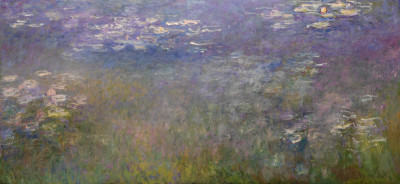
Agapanthus Triptych by Claude Monet (1916 - 1919)
(Small snippet of it below.)


This is a three piece painting that I've never seen the likes of before. The colours! The shapes! The three pieces reunited! This is the first time in over 60 years that these painting have been back together in Europe. In the 1950s Monet's family sold them, and the triptych was split up and sent to 3 separate institutions across the breadth of America. In my eyes it is a terrible pity. Almost to the point of destroying the work. (In fact, it does.) It's like separating twins at birth. 

These pieces are meant to be seen together. They are three thirds of a whole. Getting to see these in this exhibition is no doubt a once in a lifetime opportunity (unless you decide to visit multiple times.) There is something wistful about this work, something tranquil. It echoes stillness and contemplation. It really was worth the entire show.   

Below I've listed my other favourites. artists who I had not heard of before (who probably get passed over the more famous names (like Matisse. And although I do love him, he only had a small handful of paintings in this show that paled to others in comparison - hence my problem with the marketing.))

If you get a chance to go, keep an eye out for these. And if not - do Google them!
  • Frederic Bazille - Les Lauriers Roses (1867)
  • Gustave Caillebotte - Dahlias: the Gardens at Petit Gennevilliers (1893)
  • Gustave Caillebotte - Nasturtiums (1892)
  • Laurits Tuxen - Roses PS Kroyer (1893)
  • Laurits Tuxen - Rhododendron in Tuxen's Garden (1917)
  • Emil Nolde - Large Poppies (1908)
  • Kandinsky - Murano Garden II (1910)
This exhibition is open until 20th April 2016. If you can go, see it. If you do, remember, book in advance!